The onocoy Loopback: Free RTK Corrections for Up to Three Devices
Why your station does double duty, contributing to the global network and powering your own field work at no extra cost.
Most conversations about running an onocoy station focus on what the operator sends out: reference data feeding the network, rewards earned, contribution to global coverage. That's accurate, but it's only half of what the architecture actually delivers.
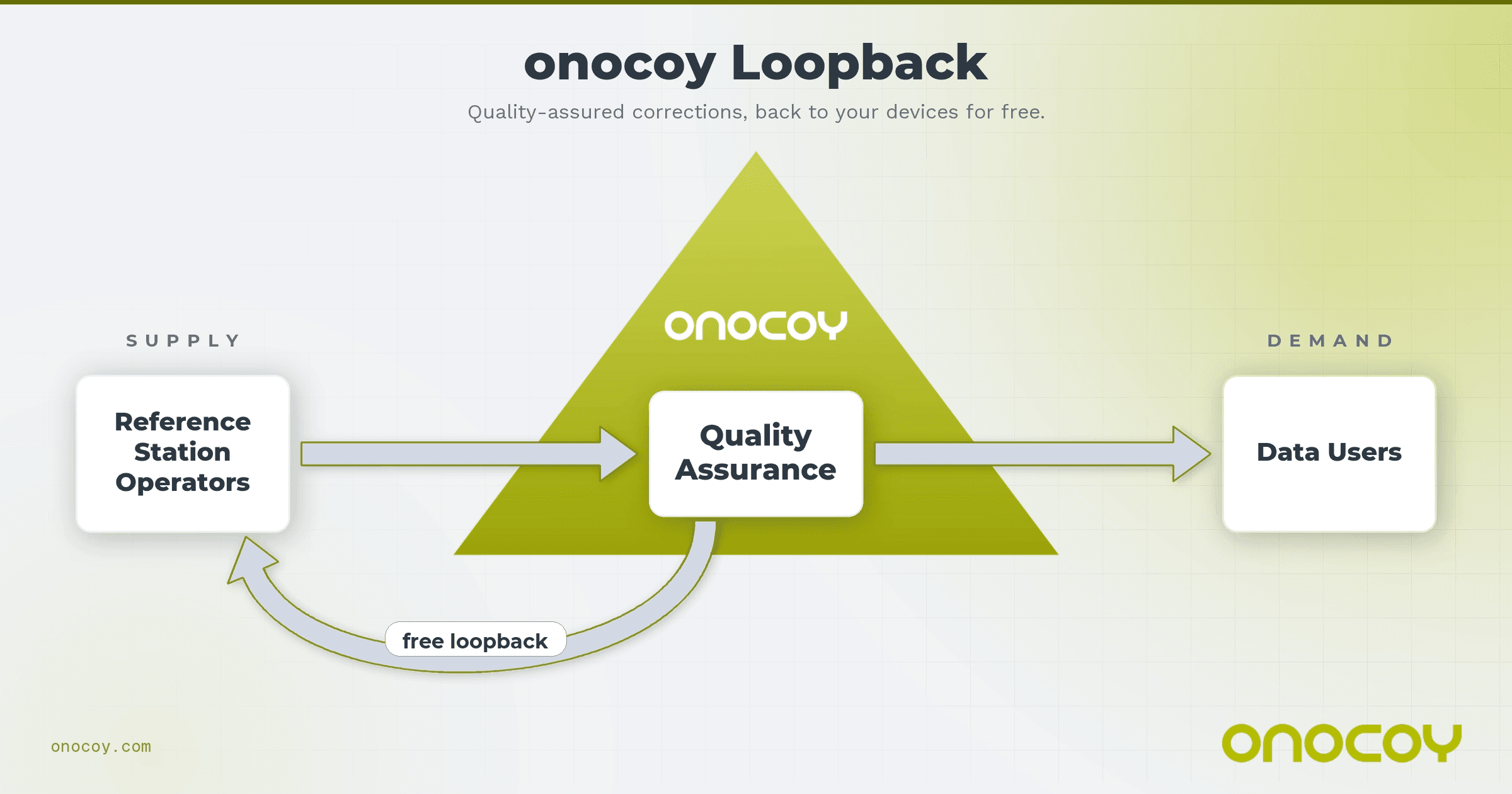
The other half is the loopback. Once your station's data has been quality-assured by onocoy, the resulting correction stream can be routed back to you, free, for up to three of your own devices simultaneously. No Data Credits required.
For farmers, surveyors, drone operators, construction crews, and research teams, that's often the part of running a station that matters most. Rewards are one revenue stream. The free loopback is what often makes the station pay for itself in operational use, even before rewards enter the picture.
How the Data Flow Actually Works
When your GNSS reference station goes live on onocoy, raw observation data flows from your hardware into onocoy's quality validation pipeline. The platform validates the data, and produces a quality-assured RTCM 3/NTRIP data stream.
That stream then has two destinations:
Data clients. Enterprise customers buying GNSS reference station data through Pay-Per-Use contracts. This is where commercial revenue comes from, which funds rewards and $ONO buybacks.
Your own devices. The same quality-assured data, routed back to you for use with your own rovers, drones, machine controllers, or any NTRIP-compatible equipment.
One distinction matters: devices with either of the two destinations receive data. Your reference station is the source, and the devices on both sides are consumers of what comes out of it.
What "Quality Assured" Means in This Context
Raw data from a single station has limits. Atmospheric conditions, multipath, satellite geometry, and equipment drift can all degrade what gets observed at any given moment. onocoy's validation layer sits between your station and any consumer of its data, including you.
onocoy's validator runs continuous quality checks on the incoming data: position stability, multi-constellation observation health (GPS, GLONASS, Galileo, BeiDou), uptime and many more things. The result is GNSS reference station data that production-grade clients are willing to pay for, backed by ongoing monitoring rather than a one-time setup verification.
When you use the loopback, you're using the same data onocoy's enterprise level clients are using. The quality bar is set by them.
That difference shows up in practice. A self-hosted RTK setup (i.e. connecting your base directly to your devices) skips this validation step. The data works, but it's only as good as your station happens to be on a given day. With the loopback, your field work gets the same scrutiny applied to data sold to enterprise clients.
Three Simultaneous Devices, No Data Credits
The loopback supports up to three concurrent connections from your own devices to your own station's corrections. That's enough to cover most real operational scenarios:
A farmer with two auto-steered tractors and a drone
A surveyor running a base station plus two rovers across a multi-team site
A drone operator with two aircrafts and a ground rover for control points
A construction site with machine control on multiple pieces of equipment
A research group running parallel measurement campaigns
The data is streamed via NTRIP. Any compatible receiver works. There's no separate billing, no Data Credit consumption for your own data, and no monthly volume cap attached to it.
If you need data from stations beyond your own (different geography, redundancy, denser coverage in a specific region), Data Credits come into play. $1 = 1 Data Credit, Pay-Per-Use, the same model commercial clients pay through. The loopback runs in parallel as a separate benefit for your own station's output.
What This Changes Economically
A reference station built from compatible hardware (GNSS receiver, multi-band antenna, mounting, weatherproofing) can be assembled for around €400. Once it's live with onocoy, that station starts earning rewards from its contribution to the network. This represents an additional income that helps amortizing the station faster.
Key Takeaways
Running an onocoy station gives you quality-assured RTK corrections from your own station for up to 3 devices free-of-charge.
The data you receive back is the same production-grade stream sold to enterprise clients.
No Data Credits are consumed for your own station's data. Data Credits only apply when you use other stations' data.
Professionals like farmers, surveyors, drone pilots, construction teams, and researchers can fully offset their station costs by earning onocoy rewards — turning their equipment into a revenue-generating asset.
The architecture is hardware-agnostic. Any NTRIP-compatible receiver can connect.
What This Means for Operators
Your can turn your reference station into a revenue generating asset while it's serving your primary use case.
This is as simple as setting it up on any NTRIP caster. Or connecting your rovers to the your base.
And you benefit from onocoy's quality assurance.
👉 Set up your station and connect your devices: docs.onocoy.com
👉 Check hardware compatibility: onocoy.com/hardware
© onocoy Association. Luzernerstrasse 74C, 6333 Hünenberg See, Switzerland
© onocoy Services AG. Luzernerstrasse 74C, 6333 Hünenberg See, Switzerland