Build the Future of Precision navigation: Why onocoy is the Global GNSS Reference Station Network You have Been Waiting For
Global Navigation Satellite Systems (GNSS) are the invisible engines of modern life. But while standard GNSS is everywhere, high-precision, centimeter-level positioning has a fundamental problem. It is time for a radically different approach.
The Fragmented GNSS Landscape
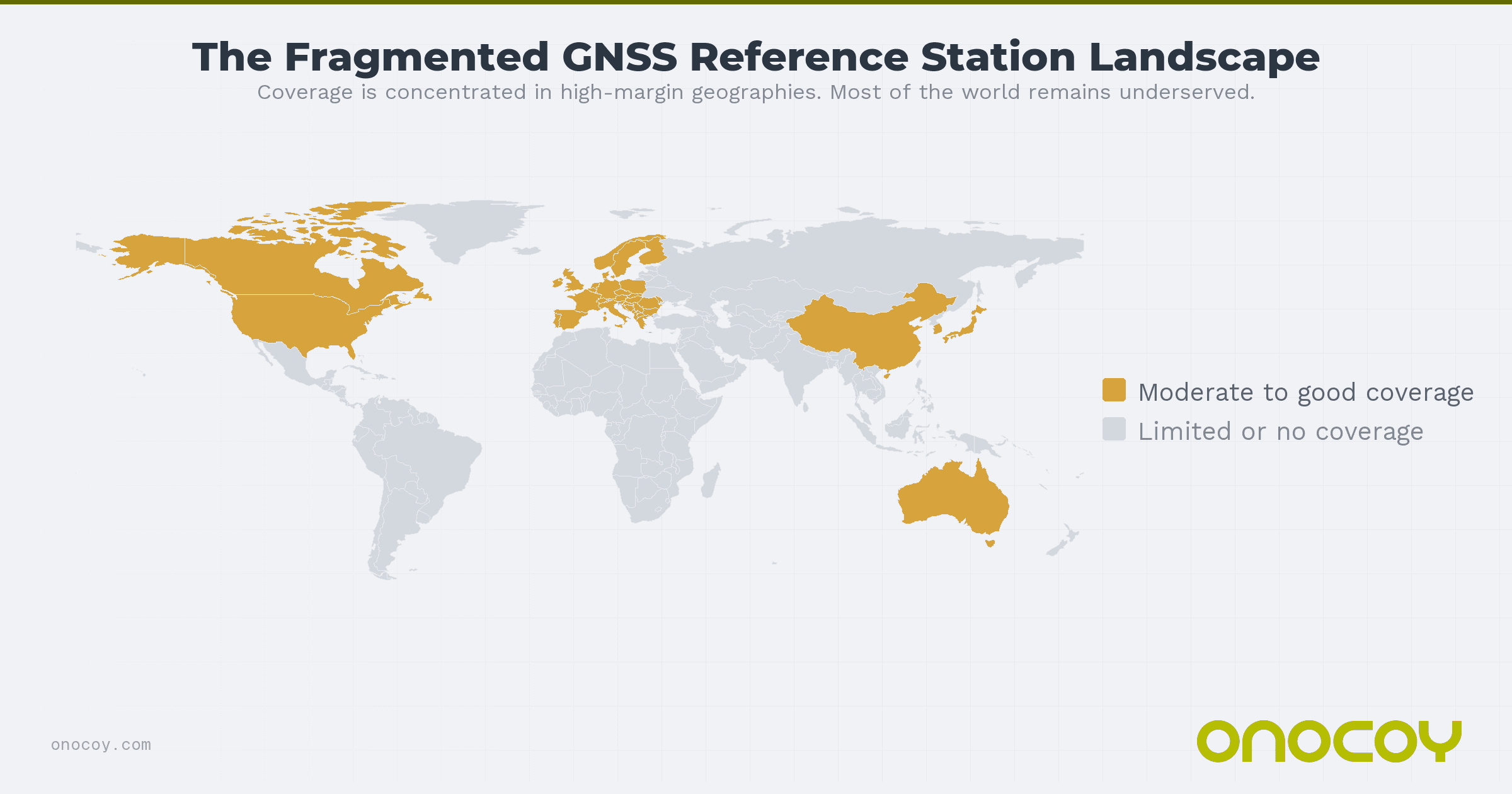
Currently, high-precision GNSS is blocked by severe structural barriers. The industry relies on highly fragmented, closed, and isolated networks that create massive bottlenecks. Because these providers face huge capital and operational expenditures, they only build infrastructure in high-margin geographies.
The traditional way of scaling just doesn't work anymore. The result? Inflated service prices for end users and large portions of the globe left underserved.
A New Approach: The Shared Virtual Network
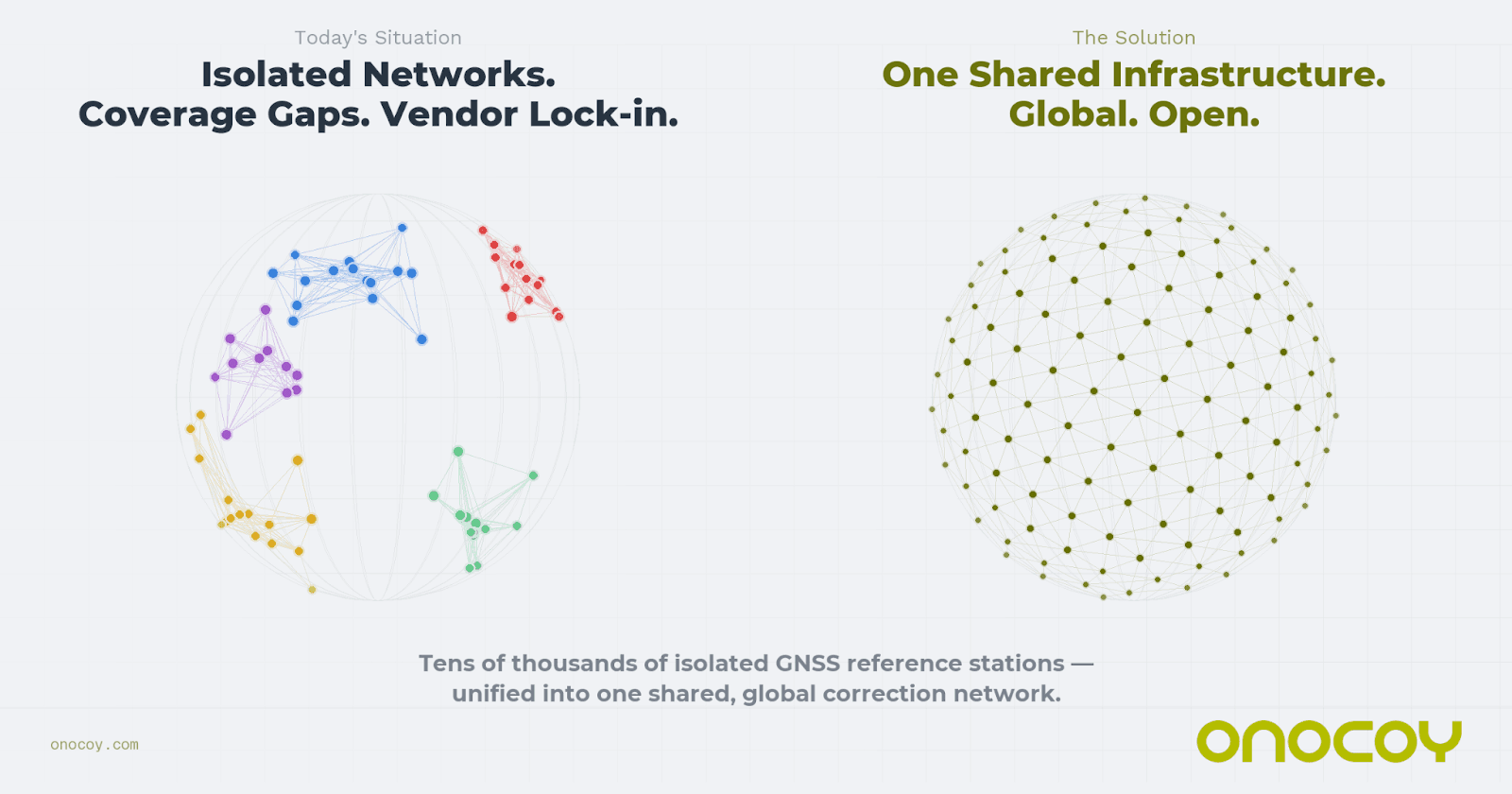
A viable solution to this bottleneck is combining these tens of thousands of isolated stations into one virtual connected system. By creating a shared, decentralized infrastructure, we can achieve a denser grid globally than any single network could ever offer.
However, executing this model successfully requires several non-negotiable pillars:
Powerful incentives: Local station operators, whether they are farmers, surveyors, universities, regional network operators or hobbyists, need compelling reasons to share their data.
A horizontal business model: The platform must act purely as an infrastructure layer that empowers an ecosystem, guaranteeing it will never compete directly with the service providers (clients) using its data nor with the operators of stations (suppliers).
Ecosystem governance: All stakeholders must be integrated into the governance to ensure the platform remains a neutral, independent body that doesn't play favorites.
Robust decentralization: To serve an entire industry, the platform needs to have a high resilience. By distributing the network across thousands of independent stations, we eliminate single points of failure. If one station goes offline, the surrounding network instantly covers the gap to keep the system running.
Massive operational efficiency: The system must seamlessly manage tens of thousands of global stakeholders remaining light and agile.
Absolute transparency: Every participant must be able to verify network operations, data quality and reward distribution within the ecosystem.
A pay-per-use system: A digital-first monetization model ensures users only pay for exactly what they consume, unlocking new downstream business models.
The Blueprint for the Ultimate Solution
The most efficient way to combine these requirements into a practical, working solution is a platform built on the following foundation:
Open standards: The system must run on established protocols like RTCM and NTRIP to ensure hardware-agnostic interoperability.
Decentralization: It must eliminate vulnerabilities through decentralization and transparency.
Modern IT infrastructure: Leveraging a cloud-native stack using MQTT and automated CI/CD (continuous integration / continuous delivery/deployment) workflows to provide a scalable, future-proof foundation that guarantees system uptime and rapid deployment of updates.
Blockchain smart contracts: To automate millions of microtransactions flawlessly, distribute rewards based on verified data quality and availability, provide total transparency, and allow all stakeholders globally to participate in the project’s governance.
A secure legal entity: The platform needs to be owned and operated by a legal entity that guarantees independence, prevents unfriendly takeovers, provides legal certainty, regulatory compliance , and funds the platform during its ramp-up phase.
Ironclad data validation: It must actively prevent any kind of fraud, spoofing, or jamming.
Enter onocoy
A non-profit association with a team of deep-tech and GNSS industry veterans set out to build exactly this platform. Led by figures like Daniel Ammann (co-founder of u-blox) and Thomas Nigg (25-year GNSS executive and former u-blox product strategist), the onocoy team has spent the last four years turning this vision into a reality.
onocoy has built a commercially proven utility. By the end of 2025, onocoy achieved an explosive 45% month-over-month growth. Today, the network boasts over 7,500 validated GNSS reference stations globally in over 160 countries.
The result is a new kind of platform:
Open instead of locked
Global instead of regional
Pay-per-use instead of expensive monthly or yearly device subscriptions
onocoy is turning precision positioning into a scalable, accessible utility, unlocking new possibilities across industries, from robotics and drones to agriculture, logistics, and autonomous systems. And it’s the foundation for large scale earth observation as in earthquake detection, or plate movement monitoring or GNSS meteorology.
How onocoy Works
onocoy operates as a non-profit association under Swiss law. This guarantees the infrastructure remains a shared, open resource.
For the station operators (aka miners), whether you run an existing commercial network or you're an individual with a base station, onocoy is a massive upgrade to your operation. Here is why you should connect your station today:
Passive Income: Station operators (miners) earn rewards on top of their current use cases. If your region happens to be an underserved High-Value Area (HVA), you can earn substantial multipliers on your rewards. You can check on onocoy’s live opportunity map to see exactly which regions currently offers these 900% reward multiplier can yield an average 900$* worth of additional income per station per year.
24/7 Enterprise-Grade Quality Control: Existing station owners benefit from continuous monitoring. You get real-time feedback on downtimes, interruptions, movements, multipath issues, cycle slips, and obstructions, ensuring your data remains pristine.
Ease-of-use: Miners have access to their station's data for personal use free of charge, benefiting not only from onocoy's quality assurance but also from a simple, quick installation..
Hardware Agnostic: With over seven hardware partners; you can integrate almost any existing or new NTRIP-compliant device.
A supportive community: You aren't operating in the dark; you are part of a community and backed by a community of GNSS miners helping each other.
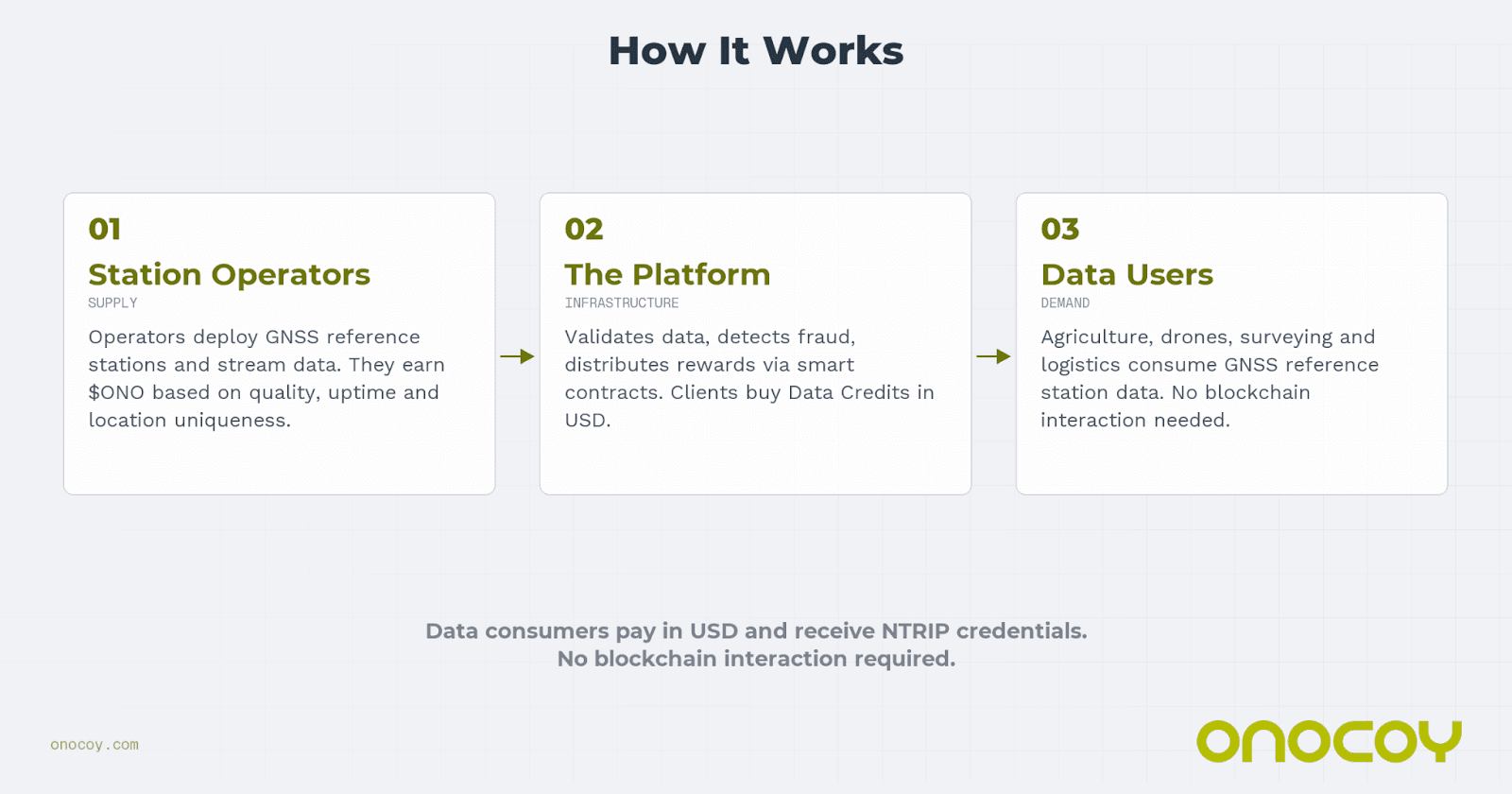
For data users (aka customers) working onocoy is straightforward. They purchase Data Credits with USD and consume them when accessing the network's GNSS reference data. onocoy’s pay-per-use model allows users to consume data exactly when and where needed. This model scales much better for the mass market than traditional annual device subscriptions, as a single account enables users to grow their business globally and immediately align operating costs with actual usage.
To protect this valuable data, onocoy is deploying state-of-the-art, fraud detection. By utilizing the team’s deep expertise and combining it with artificial intelligence, the platform actively roots out sophisticated spoofing and jamming attacks, ensuring reliability for autonomous vehicles, drones, and precision agriculture.
Tokenomics: A Sustainable, Utility-Driven Ecosystem
When evaluating a Web3 infrastructure project, the tokenomics can often seem like a labyrinth of speculation. However, onocoy’s financial architecture was engineered with a completely different philosophy: to build a stable, economically viable system that incentivizes the critical start-up phase while serving real-world stakeholders for decades to come.
To achieve this, onocoy employs a token model that separates network governance and rewards from the day-to-day cost of using the service. Here is exactly how it works, how the supply is structured, and how value flows through the system.
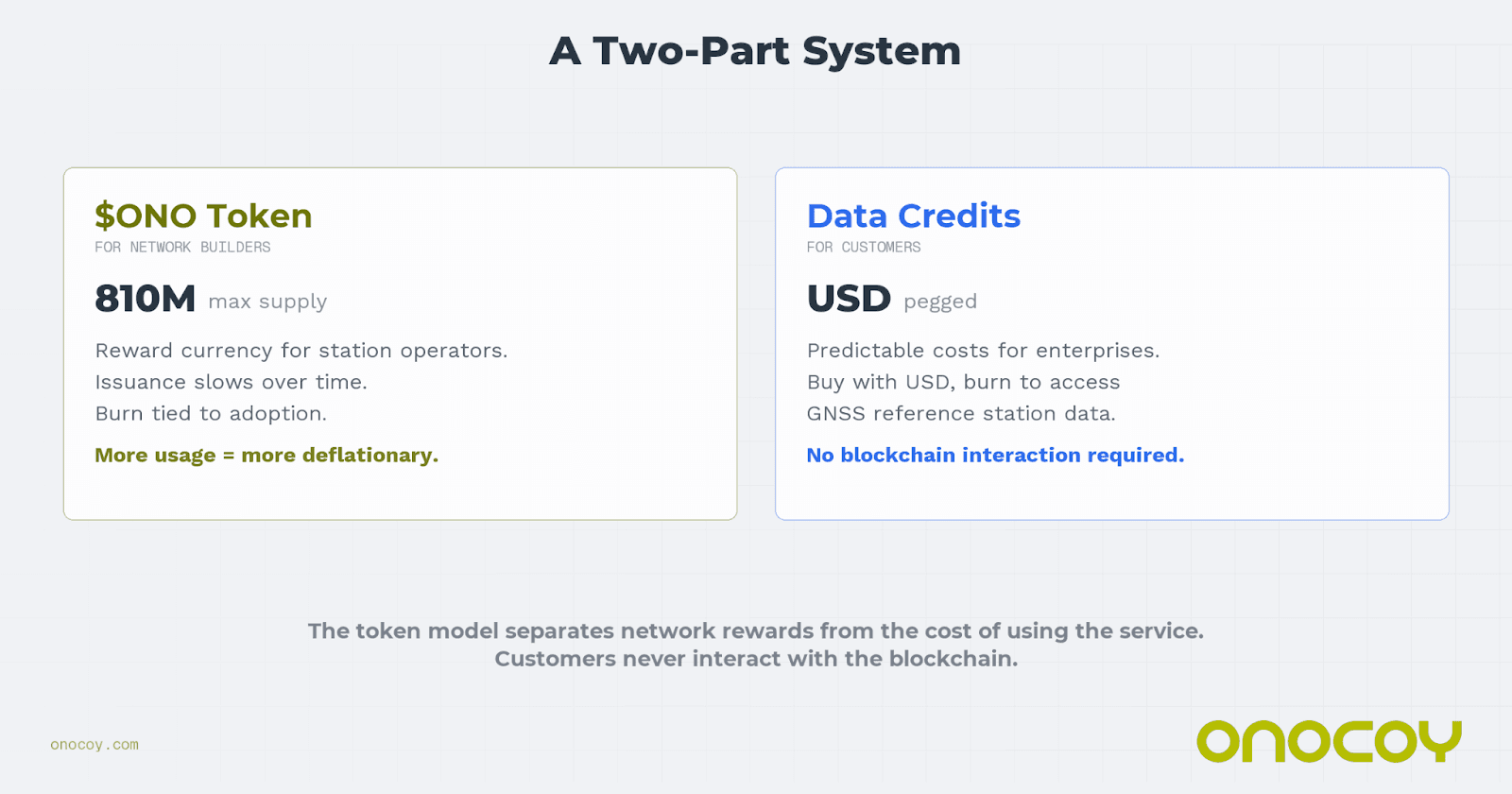
1. A Two Part System
The $ONO Token (For Network Builders)
What it is: This is the reward currency paid to the people operating our reference stations and it gives access to onocoy’s governance.
Limited Supply: There is a strict maximum limit of 810 million tokens that will ever exist.
Controlled Growth: The issuance of new tokens gradually slows down over time, ensuring supply perfectly matches the real-world expansion of our physical network. Crucially, onocoy implemented a burn mechanism tied directly to network adoption. As the volume of data consumed increases, so does the token burn rate. This creates a powerful dynamic: the higher the network adoption and data usage, the more deflationary the ecosystem becomes.
Data Credits (For Customers)
Purpose: Enterprises and end-users need predictable costs, not fluctuating token prices. Data Credits are a form of prepayment that is pegged to the US Dollar .
How they work: Users purchase Data Credits with USD and "burn" them to access the network's GNSS reference data. This guarantees that a customer’s service cost remains stable regardless of $ONO’s market performance.
2. How the Value Flywheel Works
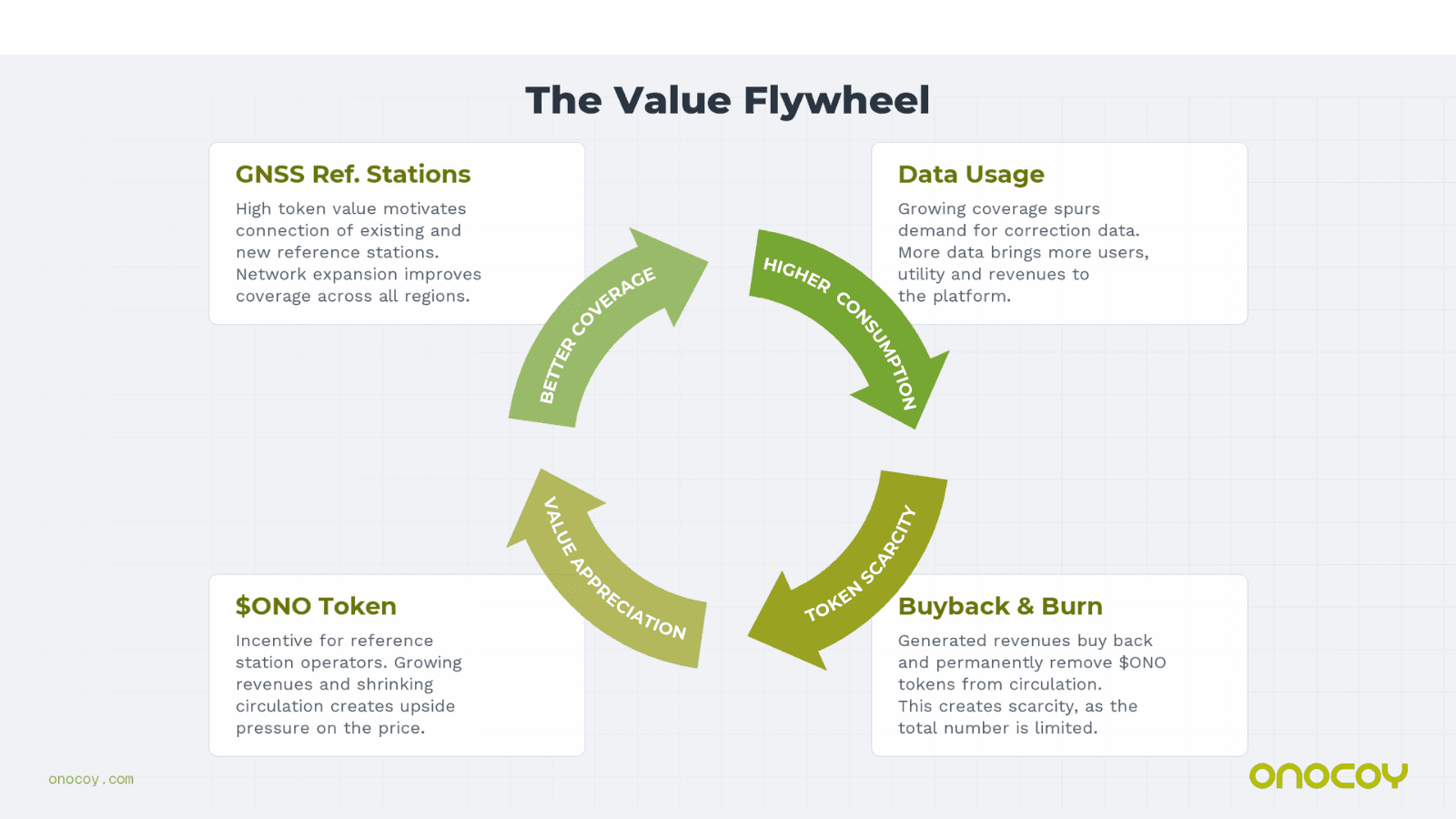
The true ingenuity of onocoy’s tokenomics lies in how it handles revenue and aligns the incentives of all participants:
Users Pay for Utility: Customers buy Data Credits with USD to consume ref. Station data, generating real-world, recurring revenue for the platform.
Smart Miner Rewards: Station operators do not just get paid for existing. They are rewarded in $ONO based on three strict metrics: data quality, uptime availability, and location uniqueness. This guarantees the network grows exactly where users need coverage, preventing clustered redundancies and rewarding those who expand the map. onocoy guides this expansion transparently through the Opportunity Map, allowing miners to deploy hardware exactly where B2B demand is highest
Additionally, (in a near future) through a local usage reward, operators earn extra income whenever their specific station's data is directly utilized by the network.The Buyback and Burn Mechanism: Because onocoy operates as a non-profit association under Swiss law, it is legally prohibited from distributing profits as dividends to shareholders. Instead, revenue generated from Data Credit sales is used to finance platform operations, and all excess capital is legally directed into buying back $ONO tokens from the open market and burning them.
3. The Supply Dynamics: Scarcity by Design to align stakeholder interests
The combination of these mechanics creates a powerful, fundamentally sound economic model. On one side the token emissions decrease over time (~16% per year) resulting in a 4-year halving cycle for new token supply. The release of new $ONO tokens to miners becomes progressively scarcer over time. On the other side, as the network secures more B2B customers and real-world usage grows, the volume of $ONO being bought back and burned increases.
This dual pressure, decreasing emissions and increasing token buybacks and burns, driven by actual user demand, creates systematic, lasting upward pressure on the value of the $ONO token. In this way, the long-term interests of the infrastructure providers (i.e. the miners) are perfectly aligned with the needs of this infrastructure (i.e. the customers), as the miners directly participate in the overall success of the ecosystem. Consequently, the token’s valuation becomes anchored in the Net Present Value (NPV) of the network’s actual business cash flows, as ongoing demand from real B2B usage drives buybacks and burns, reducing supply while reflecting fundamental revenue generation instead of purely speculative market behavior.
Blockchain often sounds like an unnecessary complication, however, onocoy uses it not to ride a trend, but because it is the only practical backend engine capable of scaling a global, shared, community-owned infrastructure.
Here is why blockchain is key to building a successful worldwide GNSS network:
Bootstrapping: Building a new global GNSS reference station infrastructure from scratch would cost hundreds of millions of dollars. Such an investment is simply not feasible. By leveraging existing infrastructure and spreading the cost of additional stations across a broad base, the financial burden on each individual miner becomes manageable.
Breaking the chicken-and-egg dilemma: Station operators need incentives to make their infrastructure available or to purchase new stations. To finance this, onocoy depends on revenue from data sales, which in turn requires a corresponding supply from miners. By issuing the ONO token with deflationary characteristics, onocoy is able to solve this chicken-and-egg problem. Miners receive tokens whose value will increase over time. This gives them the incentive to make their infrastructure available, which in turn enables onocoy to sell data, leading to long-term appreciation of the token’s value and, consequently, to profits for the miners. Miners are, in essence, small investors in the onocoy ecosystem and, as such, participate significantly from the commercial success of onocoy. This is especially true for early miners who hold onto the tokens, thereby having the opportunity to benefit disproportionately from the increase in value
Frictionless Micro-Transactions: Smart contracts on a blockchain are the only viable way to process the tens of thousands of microtransactions that occur every day in a transparent and efficient manner, without fees that are often higher than the value of the actual transaction.
Guaranteed Neutrality: Blockchain ensures onocoy remains a transparent cooperative, protecting the network from monopoly buyouts and arbitrary price hikes.
onocoy is a sustainable business driven by real-world utility:
Revenue Comes from Real Customers: The ecosystem is not funded by new members buying in. It is funded by B2B customers (surveyors, agriculture, autonomous vehicles) paying to consume RTK data.
Rewards Require Work and participation: Station operators are compensated strictly for providing validated, high-quality hardware infrastructure and reliable data streams.
Sustainable Economics: As a Swiss non-profit association, onocoy uses the revenues generated from data sales to execute token buybacks. The network's financial health is tied directly to actual product usage and traditional business metrics, not speculative hype.
Crucially, data consumers never have to interact with the blockchain. They pay in standard currency and receive NTRIP credentials. The blockchain architecture handles the complex global coordination entirely in the background, delivering a real-world utility with a seamless, traditional software experience.
A Thriving Global Ecosystem
onocoy occupies a unique position in the GNSS ecosystem: its open, non-discriminatory platform allows the industry to share the reference station infrastructure. This strictly horizontal positioning has created an ecosystem of companies along the entire value chain, all of which benefit from the global availability of GNSS reference station data:
Clients have the freedom to choose from a variety of reference stations offered through onocoy. With the platform's pay-per-use model, clients can tailor their access to data streams according to their needs. This approach grants clients full flexibility to adopt and implement the business model that aligns best with their operational requirements, enabling them to optimize both performance and cost-effectiveness for their specific use cases.
Reference station operators (miner) gain a new, or additional, distribution channel. Throughout station lifetime, they sell data to onocoy against rewards, with upside potential based on data usage in the proximity of their station. Moreover, they benefit from real-time data quality monitoring and reporting.
Correction Service Providers profit from cost-effective coverage expansion. Instead of vast infrastructure investments they utilize onocoy’s network and gain access to high-quality stations worldwide, taking advantage of a risk-free path to network expansion and economies of scale.
Product manufacturers benefit from a larger addressable market. Worldwide availability of affordable reference station data and correction services allows for mass adoption and hence increased hardware sales. Furthermore, onocoy’s global coverage gives ease-of-use in scaling products and services.
System integrators and operators can expand into new applications and services, with correction data becoming affordable and available everywhere.
As a result, consumers gain access to improved and/or new products, applications and services.
Join the Revolution
onocoy has successfully solved a structural industry bottleneck with a cooperative, highly innovative approach. Built by the GNSS industry, for the GNSS industry, it leverages modern IT and blockchain architecture to scale efficiently and fairly.
The traction is real, user adoption has grown tenfold in the last 6 months, with data consumed 8x higher than in February 2026 ,a miner base of over 7500+ stations is growing and the network is expanding in over 160+ countries. onocoy invites you to join the community today: connect your station, utilize the data, build alongside us, and become an ambassador for the invisible engine of tomorrow.
© onocoy Association. Luzernerstrasse 74C, 6333 Hünenberg See, Switzerland
© onocoy Services AG. Luzernerstrasse 74C, 6333 Hünenberg See, Switzerland